Describe the Size and Structure of the Milky Way Galaxy
It contains 100-400 billion stars andat least 50 billion planetsThe stellar. The galaxy we live in called the Milky Way Galaxy is a barred spiral galaxy composed of at least 100 billion stars.

Milky Way Galaxy Physical Geography
The halo - a roughly spherical distribution which contains the oldest stars in the Galaxy The nuclear bulge and Galactic Center.

. The Milky Way is the home galaxy of the solar systemIts abarred spiral shape galaxy. About 20000 billion solar masses. Milky Way Scales Lecture Tutorials for Introductory Astronomy 3rd Edition pages 135-138 Reading.
The Milky Way system called galaxis resembles a gigantic spiral with an estimated 200 billion stars. Its structure can be divided into three parts. Artem has a doctor of veterinary medicine degree.
1 a nucleus 2 a central bulge 3 a disk both a thin and a thick disk 4 spiral arms 5 a spherical component and 6 a massive halo. The structure of the Milky Way by Max Planck Society Fire wheel. In other words the great majority -- perhaps 90 percent.
In it there are concentrated large globular clusters these are groups of very old stars. The halo the disc and the bulb. On the left a face-on view shows the spiral structure of the Galactic Disc where the majority of stars are located interspersed with a diffuse mixture of gas and cosmic dust.
The disk is the galaxy part where stars are created. The point about which the disk of a spiral galaxy rotates. Milky Way is a galaxy contains stars gas and dust.
They come in a variety of shapes and sizes. From the Sun the distance to the Galactic Center is about. It takes its name from the Milky Way the irregular luminous band of stars and gas clouds that stretches across the sky as seen from Earth.
See answer 1 Best Answer. Milky Way Galaxy large spiral system consisting of several hundred billion stars one of which is the Sun. Tell me more about galaxies.
Previously our galaxy was thought to possess four major arms. Our galaxy is called the Milky Way because it appears as a milky band of light in the sky when you see it in a really dark area. A bright yellow cloud billowed tens of thousands of light-years upward from the Milky Ways flat disk with a fainter twin reflected below.
The galaxy named SPT0418-47 has two hallmarks of our galaxy including its rotating disk-like structure as well as the bulge or large group of. Spiral galaxies and other types of galaxies are described in the article galaxy This structure can be viewed as consisting of six separate parts. In structure our Milky Way is most similar to.
The Milky Way our home galaxy in space is a vast galaxy containing 400 billion suns at least that many planets and a 4-billion-solar-mass black hole at the center. The Milky Way Galaxys structure is fairly typical of a large spiral system. 200 billion stars in it Size of the Milky Way.
An artists impression of our Milky Way galaxy a roughly 13 billon-year-old barred spiral galaxy that is home to a few hundred billion stars. Although Earth lies well within the Milky Way Galaxy sometimes simply called the Galaxy astronomers do not have as complete an. Size and Shape of the Milky Way The Milky Way is a large barred spiral galaxy comprising an estimated 200 billion stars some estimates range as high as 400 billion arrayed in the form of a disk with a central elliptical bulge some 12000 light-years in diameter of closely packed stars lying in the direction of Sagittarius.
Explore the Milky Way the. The Milky Way system is a spiral galaxy consisting of over 400 billion stars plus gas and dust arranged into three general components as shown to the left. The Milky Way Galaxy The Milky Way is a spiral galaxy 100000 light-years wide 10000 light-years thick at the nucleus.
All the stars we see in the night sky are in our own Milky Way Galaxy. It is approximately 100000 light years across and about 1000 light years thick. -- of the mass in our galaxy must be some extra-ordinary stuff.
Start studying Structure of the Milky Way Galaxy Terms. The Milky Way is a large barred spiral galaxy. Yet the actual mass of the Milky Way based on the gravitational forces on gas and stars in its outer reaches is roughly 100 times larger.
All these elements get bound together by gravitational pull. The structure of our galaxy known as the Milky Way galaxy includes stars gas dust and nebulae. Astro 2 Textbook Reading pages 262-270 Content Video You should be able to describe the size of the Milky Way Galaxy in light-years compare the size of the solar system to the size of a galaxy describe the basic structure of the.
Learn vocabulary terms and more with flashcards games and other study tools. The annotated artists concept illustrates the new view of the Milky Way. Galaxies varies in size from 10000 to 200000 light yea View the full answer.
See how our Milky Way Galaxy. Using infrared images from NASAs Spitzer Space Telescope scientists have discovered that the Milky Ways elegant spiral structure is dominated by just two arms wrapping off the ends of a central bar of stars. It has a central bulge that is about 10000 light years in diameter.
But Nature wouldnt accept us simply sending a picture and saying OK we can see this Predehl said. The center of the Milky Way or any other galaxy. M-31 the Andromeda Galaxy.
Population I and II stars. The halo is the structure that groups the galaxy it has an exterior part and an interior part. The structure was so obvious that it barely seemed necessary to describe it in writing.
What Is The Size And Structure Of The Milky Way Galaxy Quora
Size Of The Milky Way Upgraded Solving Galaxy Puzzle Space
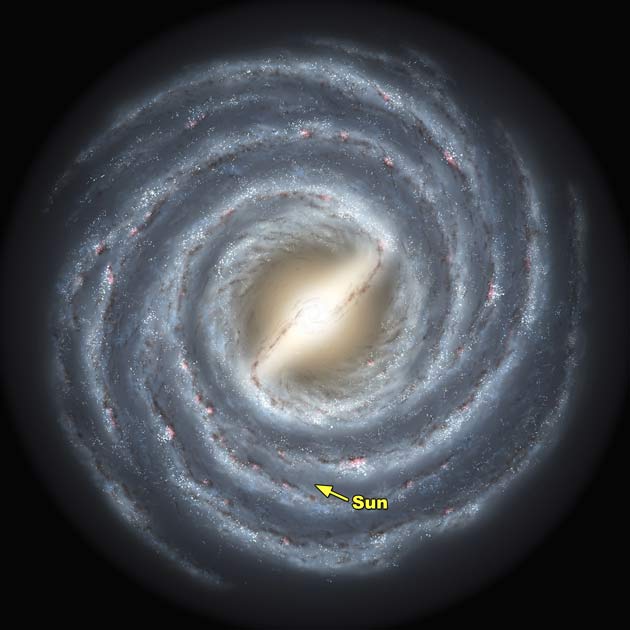
Milky Way S Central Structure Seen With Fresh Clarity Space

Comments
Post a Comment